
|
|
| |
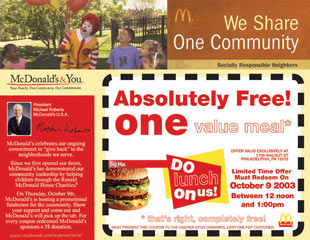
The plan was to fabricate a believable coupon and distribute it. The coupon, obviously fraudulent, was aimed at being almost too good to be true, but still believable enough to trick people into attempting to redeem it.
There were several key aspects to consider for the project. McDonalds is a corporation comprised of many different systems. We had to understand how their publications worked in order to render a coupon that was believable. We had to understand how Mcdonalds distributes their material to the public. We had to understand how the consumers acquire these coupons and of these ways, which were the best suited for our intents and purposes.
The Metro is a free newspaper released everyday. It's free, it's daily, and it's the favorite reading material for the thousands of commuters that travel the railway system each morning converging on center city. It only made sense to circulate our coupons through the Metro paper.
The coupon was only valid for one hour on one day at one location. What this does is manipulate the several aforementioned systems in very deliberate ways. The people with the coupon will have to show up at the same McDonalds at the same time, thus causing a surge in customers. The massive influx results in a capacity overload and the McDonalds, whether or not it redeems the coupons at all, will be unable to render the sheer volume of customers. Essentially it is a Denial Of Service attack.
|
|
|



