
Introduction of the unit:
"Digital human" means a computerized model of the human anatomical structure and function. Computer use is very common in industries and daily living. A computer is useful, and when a digital human model is in a computer, it starts to produce more fruitful and beneficial effects.
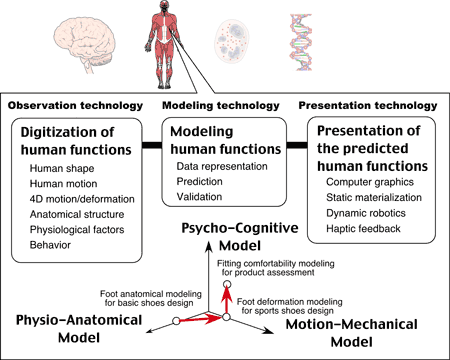 |
A human body is very complex. We will not develop a computer model that has genes, cells, or a brain and nerveous system. We focus on human functions: anatomy, physiology, motion, psychology and cognition. Our main interest is in the digital representation of these functions with an accuracy sufficient for industrial applications. Our research consists of three steps: "digitization," "modeling," and "presentation" of human functions. "Modeling" means data representation and simulation in a computer, and "presentation" means a realization of the predicted results using a CG based technique, a static shape materialization technique, and dynamic robotics.
A human body has various functions. We categorize the human functions into three groups, each of which is represented by the physio-anatomical model, the motion-mechanical model, and the psycho-cognitive model. A digital human may consist of more than one model. We develop digital humans by revising them in a 3D space whose axes are the above three functional categories
Application fields
Digital humans can be utilized for computer graphics and entertainment, ergonomics, medical training, and human computer interactions. We take an application driven approach, and develop digital humans sufficiently for practical use by collaborating with companies.
Introduction of research projects:
Digital humans for human centered design
 |
| Application images of designing a custom product using spatial grid distortion describing inter individual difference based on the FFD technique. |
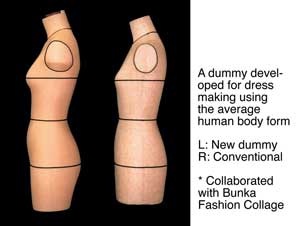
Anatomical human shape modeling and application technologies have been investigated. Digitized human surface data are modeled based on anatomical correspondence. The difference between two personal shape models is represented by spatial distortion based on the Free Form Deformation technique. Using the spatial distortion, human shape distribution and the average shape can be calculated. Calculating the spatial distortion that deforms the average body shape into the body shape of a specific individual, and by applying it to the product shape which fits to the average body shape, the custom product shape which fits to the individual can be obtained. We are collaborating with several shoe, underwear, eyeglass frames companies, etc., for the development of well-fitting products.
 |
Human motion can be discussed from the view points of common principle and individuality. For example, most people naturally assume a standing position that allow them to keep their balance. On the contrary, the motion of standing up varies due to each person's motor skills or condition at hat moment. We construct computer model of active humans which obey the basic theory of the human motion and also reflect varied individuality. This model can be applied to aid the process to design and develop a human-friendly machine.
 |
| A living space shaped sensorized environment: body motion is detected by pressure sensors and aspiration is detected by microphones. |
Behavior digitalization for human support
The purpose of this research is to "digitize" human behavior by sensing. Among the applications of the "digitized human behavior" are health care support, such as health condition management of both patients and healthy candidates, home security, etc. To attain those targets, we deal with sensing methods of human behavior and/or body movement, human models for analyzing behavior, and supporting methods based on the analysis. More concretely, our research topics include a distributed sensor network technology for digitizing human behavior in real time and a digital human model which enables physiological and behavioral analysis. We create a living-space-shaped sensorized environment where these functions are integrated. Thus, we aim at the realization of, as it were, a "virtual mother's eye"--- a function of a mother who always takes care of and supports her children.
| National Institute of Advanced Industrial Science and Technology If you have any questions about this research, please contact; Digital Human Laboratory Phone : +81-3-3599-8201 AIST Tokyo Waterfront, 2-41-6 Aomi, Koto-ku, Tokyo 135-0064, Japan |
 |